Six parts, one after the other. The power supply feeds them, and the controls tell them what to play.
Controls The app or a remote tells the streamer what to play
MusicWhere the music lives
StreamerFinds the music and plays it
DACTurns numbers into a sound wave
PreampPicks the input and sets the volume
AmplifierGives the signal the power to move speakers
SpeakersTurn the signal back into sound
Power supply Feeds the streamer, the DAC and the amplifier
The parts
Each part, one job
What it does, where it sits, and what you may already own that does it.
01
01. The music
Where the music lives
Music starts out as files: on a streaming service such as TIDAL, Qobuz or Spotify, on a drive at home, or on a CD. Web radio is music too, streamed live.
Where it sits
At the start. It reaches you over the internet or your home network.
You may already have one
Your streaming apps, the files on your computer, a USB stick, your CDs.
02
02. The streamer
Finds the music and plays it
The streamer is the brain of the system. It fetches the music over your network, keeps your queue and does what you ask in the app. It passes the music on as digital data: still numbers, not yet sound. A streamer with no DAC inside is called a transport: it sends the music out to a separate DAC.
Where it sits
After the music, before the DAC.
You may already have one
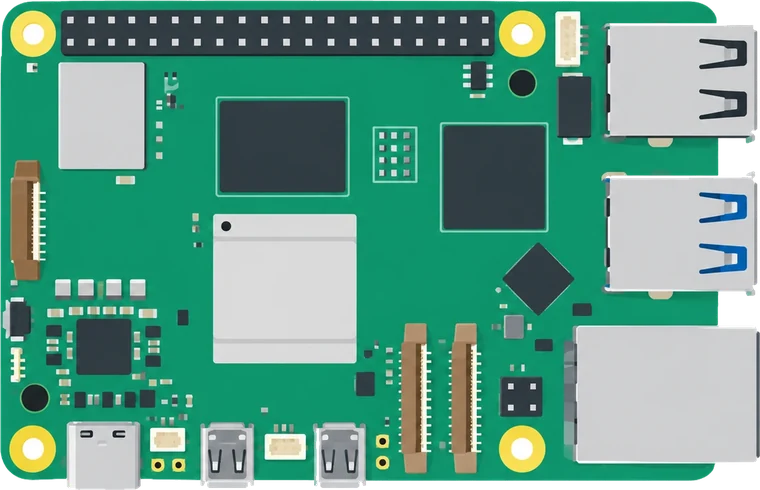
A phone or a Mac playing Spotify. A Raspberry Pi with Volumio OS.
Digital music is a long list of numbers. The DAC (digital-to-analog converter) turns them back into an electrical wave, the analog signal. A better DAC draws that wave closer to the recording.
Where it sits
After the streamer, before the preamp and the amplifier.
You may already have one
Every phone and Mac has a small one behind its headphone jack. A USB DAC, or a DAC board on a Raspberry Pi.
The preamp (preamplifier) chooses what you listen to, such as the streamer, a turntable or the TV, and sets the volume. It is often built into the DAC or the amplifier, so it may not be a box of its own.
The signal from a DAC is too weak to move a speaker. The amplifier makes it strong enough. An integrated amplifier has a preamp inside.
Where it sits
After the preamp, before the speakers.
You may already have one
The tiny amplifier in your phone drives your headphones. Powered speakers have one inside.
06
06. The speakers
Turn the signal back into sound
A speaker moves air: its drivers push and pull with the music, and you hear it. Passive speakers need an amplifier. Active, or powered, speakers have one inside. Headphones are small speakers for your ears.
Where it sits
At the end of the chain.
You may already have one
Your headphones, a Bluetooth speaker, the speakers of your TV.
Passive speakersThey need an amplifier. Speaker cable carries the amplified music to them. Most hi-fi bookshelf and floor-standing speakers are passive.Active speakersThe amplifier is inside, so they plug into the wall and connect straight to a DAC. Studio monitors and many desktop speakers are active. Wireless speakers go further: the streamer and the DAC are inside too.
07
07. The power supply
Feeds every box clean power
Every box needs power. Noise on the power line can end up in the sound, so audio gear often uses quiet, steady power supplies.
Where it sits
Beside the chain. It powers the streamer, the DAC and the amplifier, not the music itself.
You may already have one
Your phone's charger. The USB-C power supply of a Raspberry Pi.
A phone does the whole chain in your pocket. Hi-fi gear splits it into boxes. Pick one to see which parts it does.
Music
Streamer
DAC
Preamp
Amplifier
Speakers
Your phone
A phone
Everything up to the headphones is inside the phone: the streaming app is the streamer, and a small DAC, a volume control and an amplifier drive your headphones.
Then: Headphones
Your Mac
A Mac
The same in a bigger box: the music app, a DAC and an amplifier for the headphone jack. Plug a USB DAC into the Mac and the Mac becomes the transport, sending the music to the DAC.
Then: Headphones or speakers
Raspberry PiDAC board
A Raspberry Pi + DAC
With Volumio OS the Raspberry Pi is the streamer, and a DAC board on top of it is the DAC. Add an amplifier and speakers, or powered speakers.
Then: Your amplifier and speakers
Primo Plus
Volumio Primo Plus
A streamer, a DAC and a preamp in one box. Connect it to an amplifier, or straight to powered speakers.
Then: Your amplifier and speakers
Primo PlusActive speakers
Active speakers
Active speakers have the amplifier inside. Connect them to a streamer DAC, such as Primo Plus, and the chain is complete in two boxes.
Primo PlusAmplifierPassive speakers
Passive speakers
Passive speakers need an amplifier between them and the streamer DAC: three boxes, each with its own job.
RivoPreciso
Volumio Rivo + Preciso
Separates: Rivo is the streamer (a transport), Preciso is the DAC. Each box does one job, as well as it can.
Then: Your amplifier and speakers
Your turn
Pick the parts you need
The device guide asks what you have and suggests a Volumio device. Or build your own streamer with a Raspberry Pi.